
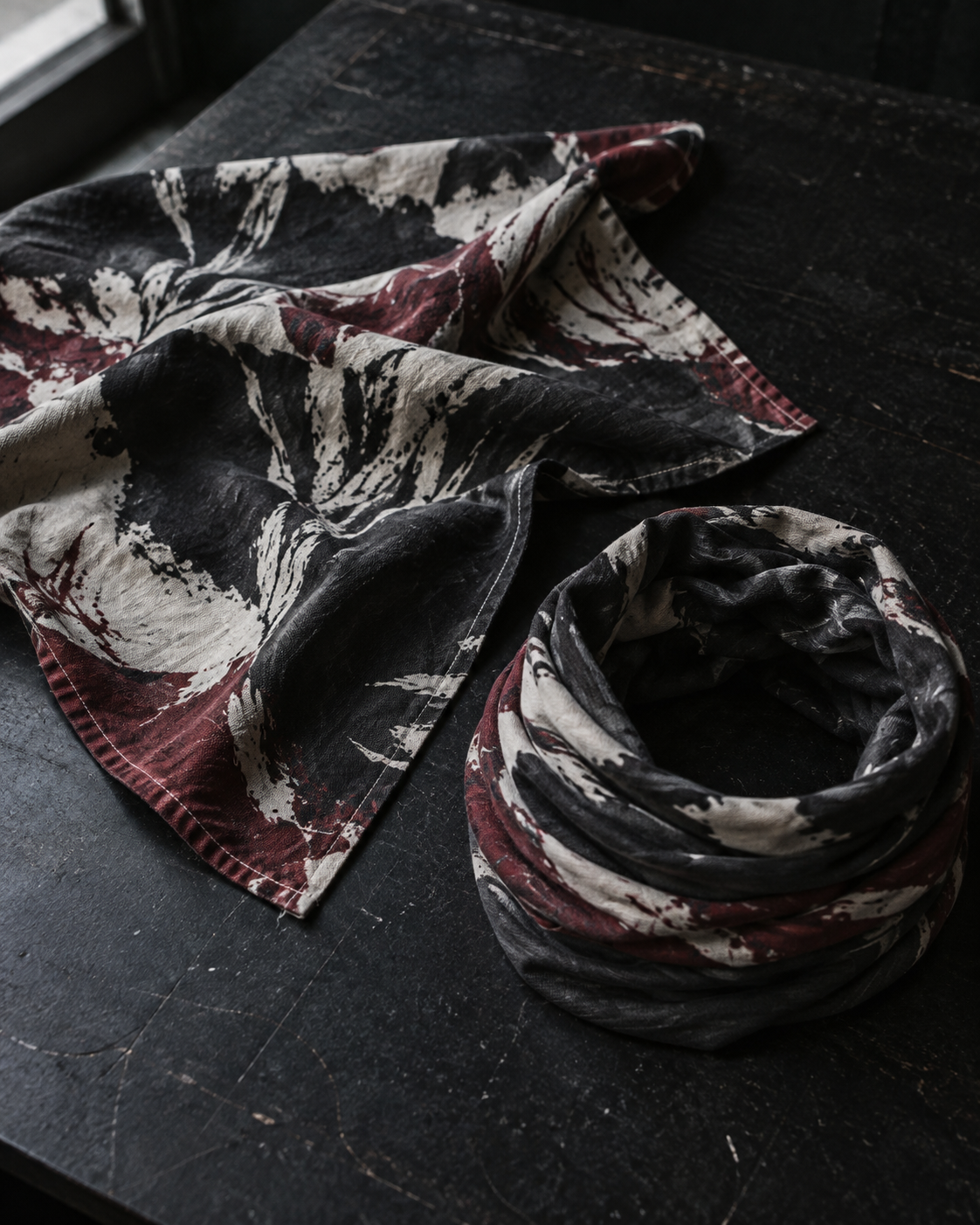
The short answer: design to the finished bandana, not only the artboard
Build the artwork at the intended physical size, reserve a safe area for critical details, define the finished edge and provide usable source files. Then approve a physical sample before scaling the design into bulk production.
A bandana is viewed flat only briefly. Most customers fold it, tie it, roll it, wear it at an angle or see it inside packaging. Artwork that looks balanced on a monitor can lose its important message at a fold, a hem or a corner. Good production artwork anticipates those realities before a printer prepares the file.
The aim is not to make a designer learn every factory setting. It is to make the commercial brief clear enough that the artwork, product specification and sample approval all point to the same result. A designer should know the finished size, printable area, bleed approach, safe zone, fabric direction, print method under consideration, edge finish and the location of any label or retail mark.
A supplier should review the file before committing to production. That review is most productive when the buyer states what cannot change: a logo, a border proportion, small text, a particular color relationship or an all-over repeat. This lets the factory flag production risks while there is still time to adjust the layout.
Start with the finished size and edge construction
There is no universal custom bandana size. A compact accessory, a classic head-and-neck bandana and a large styling square all behave differently. Rather than beginning with a popular nominal measurement, ask what coverage and styling behavior the product requires. A larger square can offer more tying options, but it uses more material and changes the scale of a border or repeat.
The finished edge consumes space and may not align exactly with the edge seen in an initial digital mockup. Define the finished measurement first, then create a trim area and a safe area. The trim area allows normal cutting variation; the safe area protects content that must not be caught in the hem or cut too close to the edge. The required allowance depends on the fabric and construction, so request the factory template rather than assuming one universal measurement.
If the design uses a frame or paisley border, give the border enough visual breathing room. An edge that looks mathematically equal in the file can appear unequal after hemming because of corner folding and the way a soft fabric moves. A sample is where that visual balance should be judged.
Prepare source files that can be checked and scaled
Vector artwork is preferred for logos, type and line graphics because it scales without pixelation. Raster artwork can be suitable for photographic or painted effects when it is supplied at the intended print size with enough resolution for the selected process.
A useful handoff normally includes the editable source file, a print-ready PDF for visual reference, linked or embedded image assets, and a note identifying fonts, spot colors or special effects. If the artwork contains licensed imagery, confirm that the buyer holds the right to reproduce it. A manufacturer can review production suitability, but it should not be expected to determine ownership of every supplied element.
Do not send a small web image and expect the printer to infer the intended detail. Enlarging a low-resolution image can make edges look soft or create unwanted artifacts. Conversely, an extremely heavy file is not automatically better. The important point is that the artwork is created or exported at the real output size and can be evaluated for the relevant printing route.
Text, very fine lines and small negative spaces deserve special attention. The minimum practical detail depends on the material, method and artwork color. Ask the supplier to identify elements that may close up, break, soften or lose contrast. That is a normal pre-production question, not a sign that the design is weak.
Use color references with realistic expectations
A monitor emits light and a textile reflects it, so screen color is not a production standard by itself. If brand color is important, provide a recognized color reference or an approved physical reference where possible. State which colors are critical and which can tolerate normal textile variation. This allows the team to focus review attention where it matters.
Color is also affected by the base fabric, its surface, the print process and viewing light. A cream base will change the perception of a pale color compared with a bright white base. A matte cotton-like surface can look different from a smooth synthetic surface even when the digital values are identical. That is why a color decision should be taken from a physical strike-off or sample, not a PDF alone.
When a program requires repeat production, keep a dated approved sample, artwork revision and color reference with the purchase record. This does not make every future run identical under all conditions, but it gives buyer and factory a shared comparison point when shade review or shipment inspection is needed.
Plan the layout for folding and wearing
Bandana artwork has a second composition: the composition after it is folded. Place important messages where they are likely to remain visible for the intended styling. A central logo can work for a neck tie, while a border mark may read better when the piece is worn as a headband. If the item is for an event, decide whether recognition at a distance or detail at close range matters more.
All-over repeats should be checked at the join. The repeat tile needs to flow without an unintended stripe or interrupted motif. Placement prints need a clear orientation, especially when a square can be folded in several directions. If there is a front, top or fold reference, indicate it in the production file rather than assuming it will be obvious from the artwork.
For a double-sided concept, specify whether the two sides use the same artwork, complementary artwork or a particular registration relationship. Do not assume that a two-sided result will behave like a single printed sheet. Discuss the intended construction and appearance during sample development.
- Mark the intended finished size and request a factory template.
- Keep key text, logos and border details inside the agreed safe area.
- State the viewing orientation and how the bandana is expected to be worn.
- Identify critical brand colors and attach the relevant reference.
- List every element that must remain sharp or legible after printing and folding.
Make the proof and sample approval process specific
A digital proof confirms content and layout. A physical sample confirms the product. Approve both, but do not treat them as interchangeable.
A digital proof is the place to verify spelling, artwork revision, placement, orientation, visible trim and label artwork. It is also the moment to catch a wrong date, reversed logo or missing layer. Record approval by revision number so no one has to guess which PDF was final.
A physical pre-production sample is the place to evaluate the real fabric, print appearance, feel, finished dimensions, hem, corners and folding behavior. Review it under conditions that resemble the product application. An event buyer may prioritize bold visual recognition; a retail brand may prioritize hand feel and presentation; an outdoor customer may need the artwork checked when a tubular product is stretched.
Before bulk production, turn sample feedback into a short approval record. Avoid comments such as looks good. State what was checked and what was approved. If a color is approved within a practical range, say so. If an element is a no-go point, identify it. This approval record is the useful link between customer requirements, factory testing and shipment inspection.
Build a responsible production handoff
The final handoff should combine art and commercial information. Include the quantity by design, product code, fabric and edge specification, approved artwork file, reference sample status, label and packing instructions, destination, delivery requirement and inspection criteria. A factory can work more efficiently when design decisions and packing decisions arrive together rather than in disconnected messages.
Packaging is not an afterthought for a branded bandana. A folded square can hide the hero graphic, a hangtag can cover a border, and a polybag label may be the first information a warehouse sees. Include a simple packing visual or order of assembly if presentation matters. During shipment inspection, open a packaged unit as a customer or receiving clerk would and verify the result against the approved reference.
For consumer-facing items, labeling and care statements should be planned with the responsible importer. The FTC notes that many textile and wool products sold in the United States have fiber-content, country-of-origin and responsible-business labeling requirements. Rules depend on the product and market, so this guide is not a compliance substitute.
Common artwork problems and the practical fix
The most frequent print problem is not a printer error; it is a file that does not describe the intended finished item. A border placed at the digital edge can be lost in the hem. A tiny logo can be technically present but unreadable when the bandana is folded. A pale detail can disappear against a fabric base that looked white on screen. The fix is to identify the non-negotiable visual element and sample it on the selected construction.
Another common gap is version control. A buyer may send one artwork file, approve a different PDF proof and later refer to an earlier mockup in email. Use one job number and one artwork revision in the filename. Keep the final PDF proof, editable source file, color reference and approved sample record together. That small discipline can prevent an outdated logo, reversed placement or unwanted edit from moving into the bulk order.
Finally, do not make packaging instructions verbal if retail presentation matters. A flat diagram showing fold direction, hangtag location, polybag orientation and barcode position can be understood by a production and packing team. It also gives shipment inspection an objective reference. This is especially helpful when the product will be unpacked by a retailer that has never seen the original sample.
Conclusion: protect the artwork before it reaches the press
The best custom bandana artwork is not just attractive on a digital board. It is prepared for the finished object: a flexible textile item that is cut, hemmed, folded, packed and worn. The file, safe area, color reference, print review and sample approval all protect that outcome.
Before you request pricing, package the product decisions with the artwork. It gives every supplier the same basis for quotation and gives your team a cleaner way to compare samples. Most expensive production corrections begin as a small assumption in the file; a clear handoff is how you remove it.
FAQ
What file format is best for custom bandana artwork?
For logos, type and line art, editable vector files such as AI, EPS, SVG or a suitable PDF are generally preferred. High-resolution raster files can work for photographic artwork when supplied at intended size. Confirm the supplier file requirements before final export.
How far should a logo be from the edge of a bandana?
Use the factory template and its specified safe area. The needed distance depends on finished size, hem style, fabric and cutting process, so there is no one fixed measurement that suits every program.
Is a digital proof enough to approve a bandana?
No. A digital proof is important for artwork accuracy, but a physical sample is needed to review fabric, color appearance, print feel, finished size, corners and folding behavior.
Can a factory match a screen color exactly?
A screen color alone is not a reliable textile standard. Supply a recognized color reference or approved physical sample for critical colors, then approve the result on the actual fabric.
References for responsible sourcing
Get a production-aware artwork review.
Share the artwork, intended size, target quantity and reference colors. We will help identify the information needed before sampling.
Ask for artwork review