
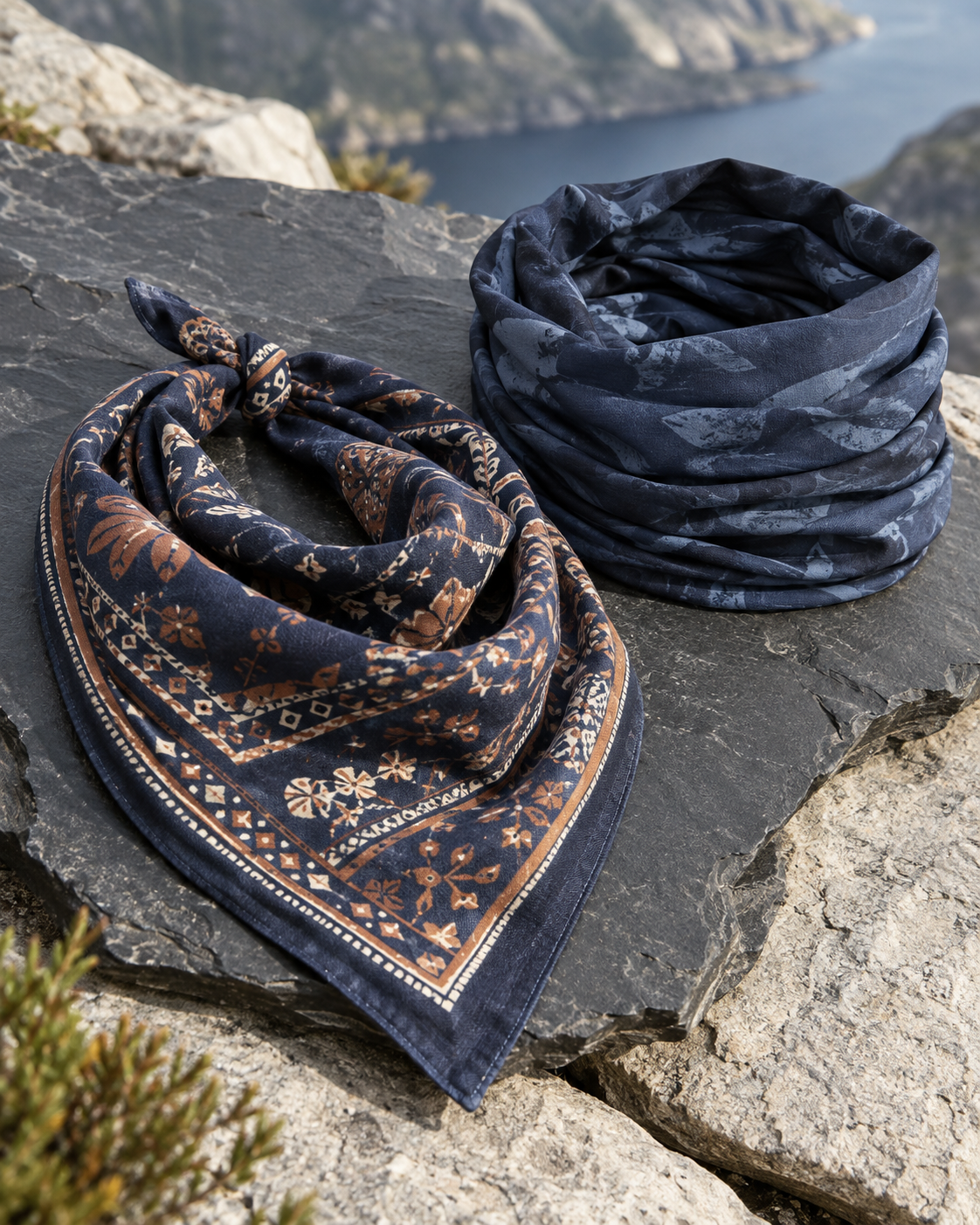
The short answer: start with climate, activity and wearer expectations
A neck gaiter for an outdoor summer event, a winter promotion and an active team program should not begin with the same fabric brief. Define temperature, activity level, desired coverage, logo visibility and care expectations before comparing materials.
Neck gaiters are simple in shape but demanding in use. They sit against the skin, are stretched over the head, may be worn around the neck or face, and are often expected to carry full-color branding. A garment that is comfortable at a registration desk may feel too warm during activity. A print that looks accurate when laid flat may distort when the tube is stretched.
The buyer brief should therefore begin with use conditions. Is the product meant for a charity run, a festival, ski-season retail, a cycling group, a staff uniform or a promotional mailing? Will wearers be active, standing outdoors, traveling, or using the item as a casual accessory? The answers guide the fabric, shape, artwork scale and inspection plan.
Do not make performance claims before they are defined and verified. Terms such as moisture-wicking, UV protection, cooling and thermal are not generic design labels. If a customer requirement depends on one of these properties, ask what evidence, test method or specification is expected for the destination market and product application.
Choose fabric by thermal comfort, stretch and print behavior
For many all-season branded programs, a lightweight polyester microfiber or other suitable synthetic knit is considered because it can be light, soft and receptive to full-color artwork. For higher-stretch fit or more active use, a suitable stretch construction may be evaluated for recovery and comfort. For cold-weather programs, a warmer construction or lining can change the product significantly, but it also affects bulk, drying behavior and the way artwork is presented.
A fabric swatch should be handled and stretched, not only viewed. Check how quickly it returns after extension, whether the surface becomes too sheer when stretched, whether the edge curls or rolls, and whether the print looks continuous around the tube. A product that will be worn over the face should also be evaluated for breathability and perceived comfort, without assuming that one material performs the same way for every wearer or activity.
| Program direction | Fabric priorities to discuss | Questions for the sample |
|---|---|---|
| Summer event or running program | Light weight, air movement, quick drying, print clarity | Does it feel comfortable after activity? Does the print stay readable when stretched? |
| All-season promotion | Soft hand, practical care, versatile coverage | Is the tube easy to pull on? Does the artwork work in several wearing positions? |
| Cold-weather activation | Warmth, lining or denser construction, bulk control | Is the item still easy to fold and pack? Is the logo visible over the chosen construction? |
| Retail or private-label launch | Hand feel, finish, repeat consistency, labeling | Does it meet the approved sample across sizes, colors and packed presentation? |
Get the fit and shape right before print scale
A tube shape can be produced in different lengths, widths, taper directions and seam arrangements. The practical size depends on the target wearer and whether the item needs to cover the neck, lower face, head or several positions. A one-size program should still identify the intended target range and the preferred fit: relaxed, close, long, short or multi-use.
Artwork scale should be reviewed on the actual circumference. A logo sized for a flat template may become too wide, narrow or distorted when the fabric is pulled over the head. The sample should be inspected relaxed and stretched. For a directional print, specify the top, front or preferred viewing orientation. For an all-over repeat, check continuity at the seam or join and make sure no accidental blank or hard line appears.
If the product will be issued to a large group, consider packing and distribution while choosing the size. A compact folded gaiter may be easy to include in an event kit, while a heavier lined version changes carton volume and packing preparation. Those details influence both user experience and shipping cost.
Prepare artwork for a flexible tubular product
A good neck gaiter file shows the full print area, safe zones, orientation and artwork behavior when the fabric stretches. It should be assessed as a worn item, not only as a flat rectangle.
For a full-wrap design, request the factory template for the selected construction. Mark any critical logo or text position and keep it inside the confirmed safe area. Avoid placing mandatory copy at an edge, seam or likely fold unless that position has been sampled. Small text can be difficult to read on a moving, curved, flexible surface even if the digital file looks precise.
Color-heavy artwork benefits from a physical strike-off. Light grounds, dense dark areas and subtle tonal changes can appear different once printed and stretched. If a customer has a critical brand color, supply a usable reference and agree how shade will be reviewed. A digital mockup remains useful for approval, but it cannot replace the material-specific check.
A simple wear map can save revisions. Show where the wearer is likely to see the main logo when the item is used as a neck tube, face cover or headband. If all three positions matter, design with that in mind instead of treating the tube as a single front panel.
Set a quality plan that fits the program
Quality control should be connected to the actual order risks. For a branded event item, print orientation, readable logos, consistent packing count and delivery timing may be the highest priorities. For a private-label product, the inspection plan may add finished measurements, seam appearance, label placement, surface defects, shade consistency and retail packaging presentation.
Factory testing should be specified rather than assumed. If the customer needs an evaluation for colorfastness, light exposure, wash behavior, stretch recovery or another property, identify the expected test method, condition and acceptance criterion before production. ISO and AATCC publish testing frameworks used in textiles, but the buyer and supplier still need to agree what is relevant to the product and market.
During shipment inspection, inspect both individual units and the packed order. Review a representative unit against the approved sample, stretch the item to check artwork behavior, measure the finished item according to the agreed method, verify the label and open a packaged set. Check outer-carton marks, assortments and quantity records before release.
Quote preparation: what buyers should send
A supplier can only quote the version of the product it understands. A clear request avoids comparing prices for different assumptions about fabric, size, finish or packing. Explain whether you are buying a sample, a one-time event order, a retail launch or a repeat program. State the quantity by design and whether the product needs individual packing, barcode labels, hangtags or insert cards.
If time is important, separate the deadline you need from the date by which artwork and sample approval can realistically be complete. Production time cannot begin in a meaningful way while critical material, artwork or approval decisions remain open. This is not a reason to delay a project; it is a reason to make the decision path visible early.
- Program type, country of delivery and in-hands date
- Target quantity per artwork and forecast for repeat orders
- Preferred fabric direction and non-negotiable product properties
- Finished dimensions, tube shape and seam or edge preference
- Artwork file, logo placement, orientation and color reference
- Packaging, labeling, carton marking and any retailer requirements
- Sample approval and shipment inspection criteria
Care, labeling and responsible claims
Care information and labeling are business-critical for many consumer-facing programs. Requirements vary by market and product. In the United States, the FTC provides guidance on textile fiber, country-of-origin and care information for covered products. The responsible importer should verify the labeling plan for the final item rather than copying language from an unrelated product.
Be equally careful with functional claims. A fabric may be chosen for a light, breathable feel, but claims such as UV protection, antimicrobial treatment, cooling performance or filtration should only be used when the final product has the appropriate substantiation for the claim and market. A clear, honest product description builds more trust than a broad performance promise that cannot be documented.
For reusable event items, the care note should follow evidence from the product or fair sample. The FTC care-labeling guidance emphasizes a reasonable basis for care information. That is a useful principle even when the specific rule does not apply to a particular item: test or verify the care guidance before passing it to the end user.
Plan the order timeline around decisions, not only the event date
A neck gaiter program has several decision gates: artwork readiness, fabric selection, sample review, bulk approval, packing confirmation and dispatch planning. Start by counting back from the in-hands date, then identify who approves each gate. A calendar that only shows the final event date hides the work that must happen before production can be released.
The most useful early question is what must be true before a sample can begin. It may be a final logo, a confirmed fabric direction, a finished-size decision, a packaging requirement or a target delivery country. Identify these dependencies in the first brief. If any are still uncertain, ask the supplier to explain which estimate is provisional and what information could change it.
For event orders, build a small buffer after shipment inspection for freight handover, receiving and kit assembly. For retail orders, include barcode review, carton marking and any retailer booking process in the timeline. These are not factory production steps, but they can decide whether a completed product reaches the customer when planned.
Conclusion: make the neck gaiter work where it will be worn
A custom neck gaiter becomes a strong branded product when the design is made for the actual use condition. Climate, activity, fit, fabric, print stretch, artwork orientation, packing and quality checks all work together. The most attractive flat mockup is not enough if it becomes uncomfortable, unreadable or inconsistent in use.
Build the brief around the wearer first, then use a physical sample to resolve the details. Once the product is approved, carry that reference into factory testing and shipment inspection. This is the practical route from event concept or retail design to a repeatable bulk program.
FAQ
What fabric is commonly used for custom neck gaiters?
Lightweight polyester microfiber and suitable stretch knits are common directions for many branded programs, but the right fabric depends on climate, activity, desired stretch, hand feel and print requirements. Review the actual sample before approval.
How should artwork be checked on a neck gaiter?
Check it both relaxed and stretched, and in the intended wearing positions. Confirm logo orientation, repeat continuity, text legibility, seam behavior and how the print looks around the circumference.
Can a neck gaiter carry a UV or cooling claim?
Only use a functional claim when it is supported for the final product and the relevant market. Discuss the required evidence and test criteria with the responsible compliance adviser before making the claim.
What should a neck gaiter shipment inspection include?
Inspect finished dimensions, fabric and workmanship, print orientation, artwork behavior when stretched, labels, individual packing, assortment and carton marks against the approved sample and purchase order.
References for responsible sourcing
Start with the use case and build a clearer gaiter brief.
Tell us the climate, activity, quantity, artwork and packing requirements. We will help organize the sampling questions before production.
Get a gaiter quote