
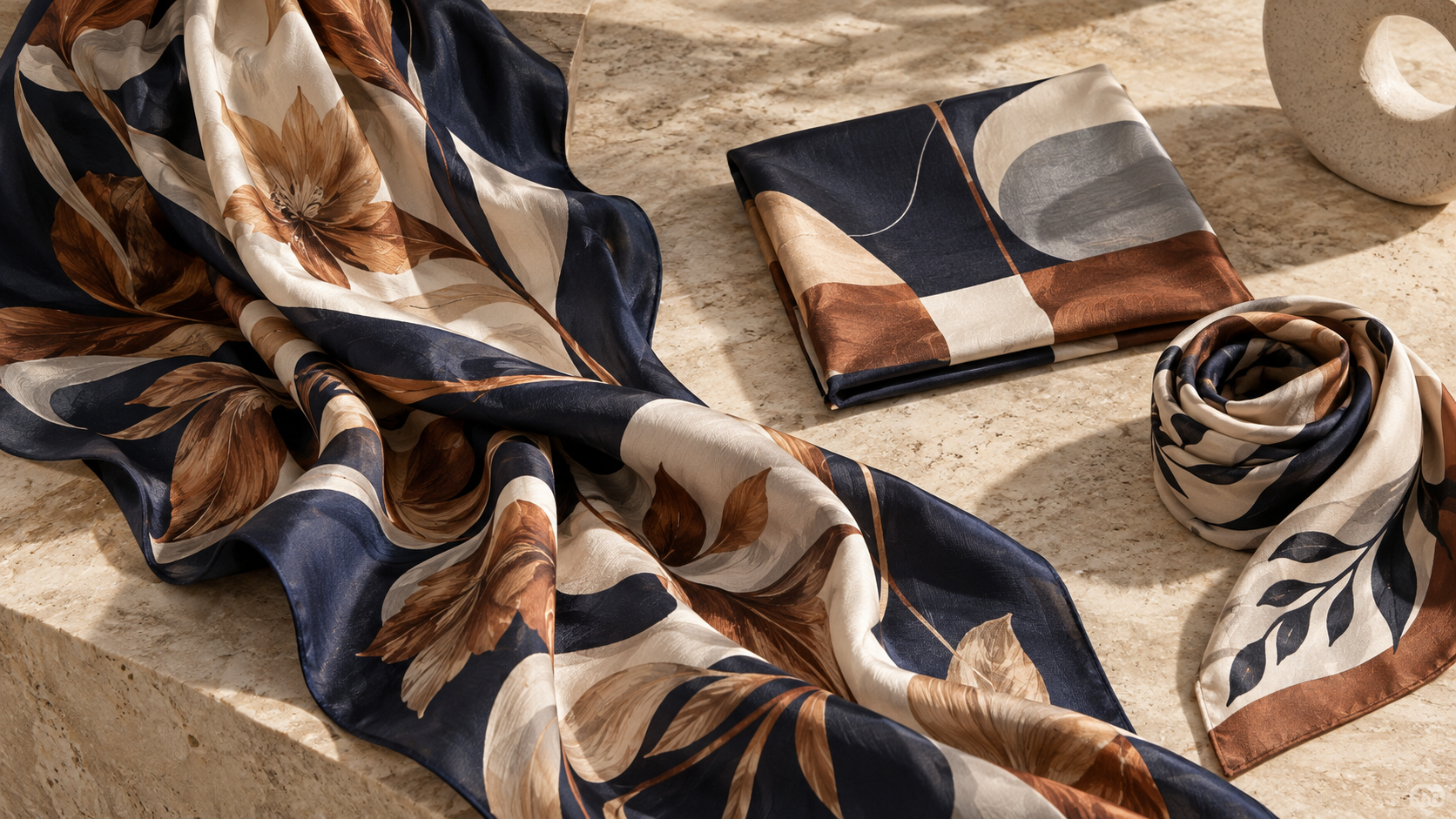
The short answer: choose for use, not for a fabric name
For fashion scarves, prioritize drape and surface character. For promotion, prioritize readable branding and practical care. For active use, prioritize stretch, breathability and recovery. The right print method is the one that supports those requirements on the selected fabric.
Buyers often begin with a phrase such as silk feel, cotton bandana, or microfiber scarf. That is useful, but it is not yet a production specification. Two fabrics with a similar fiber description can differ in weight, weave, opacity, surface sheen and how they accept ink. Those differences show up in the hand feel, the perceived quality of a print and the way a scarf behaves when it is tied.
A stronger request defines the product application first. Is the piece a 90 cm fashion square for a retail collection, a 22 inch event bandana, a lightweight neck tube for a cycling team, or a gift-with-purchase accessory? The answer changes the practical balance between drape, coverage, color density, edge treatment and packing.
This is also why a swatch review should happen before a large order. A screen proof can confirm layout, but it cannot tell a buyer whether a pale ground looks too transparent, a dark print feels too heavy, or a finished edge changes the apparent size. A physical sample connects the brief to the product application.
Build the fabric brief around four visible characteristics
The most useful fabric discussion is not limited to fiber content. Ask the supplier to compare fabric directions against the properties a customer will notice when the product is worn or handled. Weight should be discussed as a range agreed from the actual swatch rather than as a generic promise. A light fabric can feel elegant and pack compactly, but may reveal more of the base color and needs a considered print design. A denser fabric can provide more coverage and structure, but may be less fluid.
Surface and construction matter just as much. A smooth woven surface can make fine artwork and gradients appear crisp. A natural-looking woven surface can suit a casual bandana program. A stretch knit can be better for a tube-style gaiter, provided the artwork is assessed when the fabric is extended as well as relaxed. The fabric should be evaluated under normal indoor light and in the intended use condition, not only flat on a sampling table.
| Fabric direction | What buyers typically evaluate | Common product application |
|---|---|---|
| Smooth woven polyester | Fluid drape, surface sheen, color detail | Fashion squares, gift programs, retail accessories |
| Light woven cotton or cotton-rich fabric | Natural hand, casual character, absorbency | Classic bandanas, lifestyle merchandise, events |
| Polyester microfiber or stretch knit | Breathability, stretch, fast drying, print continuity | Neck gaiters, outdoor events, team programs |
| Heavier woven scarf fabric | Coverage, structure, premium weight | Cool-weather accessories and structured styling |
Match the print method to artwork and fabric
Detailed multicolor artwork generally needs a method that can reproduce continuous color and fine elements on the chosen base. Limited-color graphics may suit a simpler method. The decision should be made after reviewing artwork, fabric and target quantity together.
A print method is not a visual style choice alone. It affects color appearance, hand feel, production route and how the reverse side may look. A buyer should provide the final or near-final artwork before committing to a method, especially when the design uses photographic detail, tonal gradients, very fine lines, large solid areas or a critical brand color.
For full-color all-over artwork on a compatible polyester base, dye-sublimation is frequently considered because the artwork can run edge to edge and because it is well suited to complex color. It should still be reviewed in a physical sample because color perception changes with fabric construction and base whiteness. A limited-color graphic may be better evaluated for screen or pigment printing depending on the fabric, design and order profile. Do not assume that a method used on paper or apparel will produce the same result on a lightweight scarf.
Ask what happens at the reverse, near the hem, and at folded points. A print that is compelling when flat can look different when tied. If a design has an important logo, consider whether it should remain visible after common folding positions. If a border is important, protect it with an appropriate safe area rather than placing it directly at the cut line.
Treat size, hem and labels as part of the quality decision
A custom headscarf is cut from flexible material, so the finished size and tolerance should be agreed before sample approval. Size affects how the scarf ties, how a pattern is viewed, fabric yield and the look of an edge. A brand should state whether the finished measurement is the key reference and whether the item will be assessed flat, gently relaxed or after specified care.
The edge finish deserves a dedicated review. A narrow machine hem, a rolled finish and a different edge construction each create a different visual line and can affect the printable area. The most useful sample comments are specific: confirm the finished measurement, inspect corner consistency, check that the border remains balanced, and confirm that the label placement does not interfere with the product application.
For retail programs, plan labels and care information early. Requirements vary by destination and product classification. For US-bound textile products, the Federal Trade Commission explains that most textile and wool products need fiber content, country-of-origin and responsible-business information, while care labeling requirements can also apply to covered apparel. Confirm the final labeling plan with the importer or compliance adviser before production.
What a production-ready sample approval should cover
Approve the physical sample only after checking artwork, color, feel, size, edges, labels and packing against the written brief. A clean approval record gives the factory and buyer the same reference during bulk production and shipment inspection.
A practical approval sheet can be concise, but it should leave no ambiguity about the priorities. Include the approved artwork revision, base fabric direction, finished dimensions, edge construction, label artwork, packing requirement and the agreed reference sample. If a brand color is critical, note how it will be evaluated and under what lighting condition. If the product is intended for outdoor use, discuss whether light exposure or repeated laundering is relevant to the product application.
During factory testing or pre-production review, buyers can ask which checks are relevant to the item rather than requesting a generic pass statement. For example, a program may require measurement checks, workmanship inspection, print placement review, shade comparison, rub assessment, wash-related evaluation or packing verification. The applicable test method and acceptance level should be agreed in the purchase order; an international standard is a test framework, not a guarantee that every product automatically meets a buyer requirement.
Shipment inspection works best when it follows the approved sample and documented critical points. If presentation matters, open an export carton and inspect the folded product, label visibility, polybag or belly band, and carton marking exactly as a receiving team would. This prevents a common gap: a scarf may look correct when unfolded but arrive in a retail presentation that does not match the customer requirements.
A buyer checklist before requesting a quote
A quote becomes more comparable when all suppliers receive the same production brief. Include a target quantity per design, destination, desired delivery window and whether the order is a sample, launch, replenishment or promotional program. If you are comparing options, ask each supplier to separate what is confirmed from what still needs sampling.
Do not rely on a single adjective such as premium or soft. Identify the priority in order: print detail, drape, opacity, natural hand, stretch, price target, care behavior or lead time. This helps a supplier recommend a realistic option rather than a broad catalog answer.
- Product application and target wearer
- Finished size, shape and allowable tolerance
- Artwork file, border or placement instruction, and color reference
- Fabric priorities: hand feel, weight range, opacity, stretch or breathability
- Preferred print direction and the elements that must remain sharp
- Edge finish, label, hangtag and packing requirement
- Sample approval process and shipment inspection points
How to compare supplier recommendations fairly
When suppliers recommend different materials or print routes, do not compare the prices in isolation. Put each quotation beside the same matrix: fabric construction, finished size, print coverage, number of designs, edge finish, label, individual packing, sample cost, production lead time, shipping terms and inspection scope. A lower unit price can reflect a different assumption rather than a more efficient solution.
Ask each supplier to identify the open decisions. For example, a quote may be based on a stock white fabric, while a second quote assumes a special base color. One may include a full-bleed print, another may assume a smaller printable area. One may price bulk packing, while another includes retail-ready presentation. The point is not to force every supplier into one process; it is to make the comparison transparent.
For new supplier relationships, a small, documented sample stage can be more valuable than a large amount of early correspondence. Send the same artwork and brief, compare the resulting fabric, color, edge and packing, and record the strengths or gaps against your actual customer requirements. That record becomes useful again when the program is repeated or when a second design is added.
Conclusion: a useful brief prevents expensive assumptions
The most reliable custom headscarf program does not begin by selecting a fabric from a photo. It begins with the use case and moves through a connected set of decisions: fabric construction, print behavior, finished size, edge detail, labeling, sample approval and delivery presentation. That sequence makes it easier to compare supplier recommendations on practical grounds.
If you are choosing between two fabric directions, request samples using the same artwork and finish. Compare them side by side, folded and worn, then record the decision against the intended application. The extra clarity at that stage is far less costly than changing material expectations after a bulk order has started.
FAQ
What fabric is best for a custom printed fashion headscarf?
A smooth woven fabric is often a sensible starting direction when fluid drape and detailed color are priorities. The final choice should be confirmed with a physical sample because weight, opacity, base color and edge finish all affect the result.
Can I use the same artwork on cotton and polyester?
You can use the same design concept, but color, detail and hand feel may reproduce differently. Ask for a sample or strike-off on the actual fabric before approving bulk production.
What should be checked during shipment inspection?
Check finished dimensions, workmanship, print placement, shade against the approved reference, labels, packing and carton marks. Add any product-specific checks to the purchase order before production begins.
Do all headscarves need a care label?
Requirements depend on the market and product classification. US-bound products should be reviewed against applicable FTC labeling guidance, while other markets may use different rules. Confirm with the importer or compliance specialist.
References for responsible sourcing
Turn the product idea into a sampling brief.
Send the intended use, artwork, quantity and fabric priorities. We will help organize the information needed for a practical sample review.
Send your requirements